

Forest Soccer
- Players: 10 – 22
- Duration: 60 - 70 min
- Average cost: $12
- Age: 4+
How to play
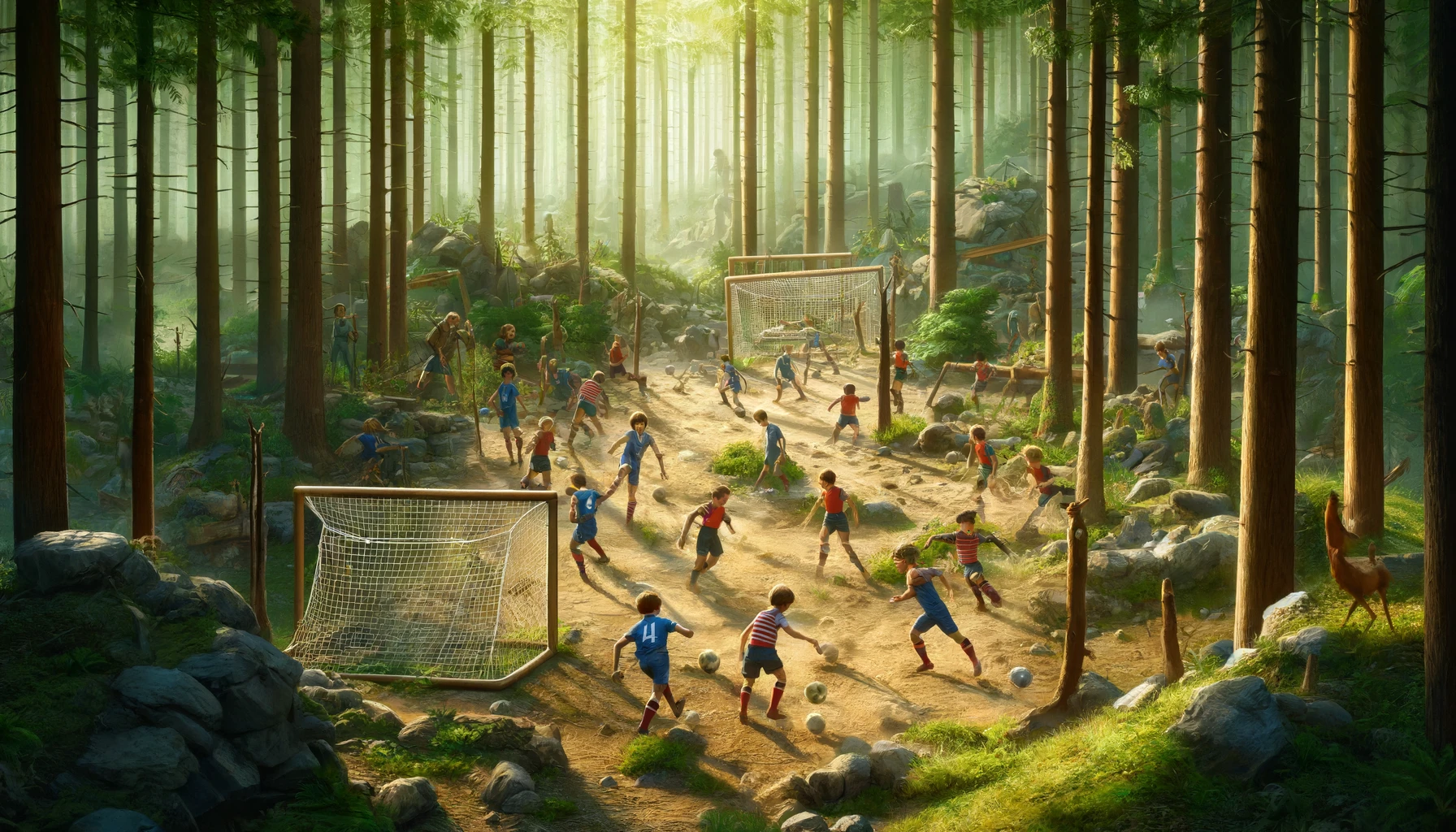
Regular soccer rules, wildly irregular field: play in a forest, on a slope, or anywhere full of natural obstacles. Mark two goals a good distance apart — a gap between two trees works — and let the terrain do the rest. Trees become defenders, roots redirect passes, and the ball is never where you expect it. Keep teams small so everyone stays involved, agree on boundaries before kickoff, and walk the area first to clear anything genuinely dangerous.
What you'll need
- Forest Area
- Goal Markers ↗
- Soccer Balls ↗
- Team Jerseys or Colored Bands -
- Cones or Markers ↗
- Safety Equipment (Shin Guards, Helmets)
- Footwear (Sneakers, Cleats)
- First Aid Kit ↗
- Whistle ↗
- Drinking Water
- Trash Bags
As an Amazon Associate, Group Games earns from qualifying purchases.
Overview
Forest Soccer is a thrilling variation of traditional soccer played in a forest or an area with numerous natural obstacles. This version of the game adds an exciting twist by incorporating trees, rocks, and other natural features, which players must navigate around while playing. It’s suitable for children aged 6 and up and can be enjoyed by small or large groups.
Objective
The objective of Forest Soccer is the same as traditional soccer: score more goals than the opposing team by getting the ball into the opponent’s goal. However, players must skillfully maneuver around natural obstacles in the playing area.
Game Setup
- Players: 6 to 20 players.
- Age: Suitable for players aged 6 and up.
- Playing Area: A designated area in a forest or a similar environment with natural obstacles like trees, rocks, and uneven terrain.
- Equipment:
- Soccer ball
- Portable goals or makeshift goals (e.g., using cones or marked areas)
- Cones or markers to outline the playing field
- Teams: Divide players into two equal teams.
How to Play
- Set Up the Field: Use cones or markers to outline the playing field. Set up goals at each end of the field.
- Divide into Teams: Split players into two teams of equal size.
- Explain the Rules: Briefly explain the rules of the game, emphasizing the importance of navigating around natural obstacles safely.
- Kickoff: Start the game with a kickoff from the center of the field.
- Gameplay: Players try to score goals by kicking the ball into the opponent’s goal while avoiding obstacles.
- Duration: Play two halves, each lasting 15-20 minutes, with a short break in between.
Rules
- No Touching the Ball with Hands: Except for the goalkeepers, players cannot use their hands to touch the ball.
- Navigating Obstacles: Players must avoid crashing into trees, rocks, and other obstacles. If a player hits an obstacle, play continues unless there is a safety concern.
- Out of Bounds: If the ball goes out of the designated playing area, it is returned to play with a throw-in from the point where it went out.
- Fouls and Free Kicks: Standard soccer rules for fouls apply. Free kicks are awarded for infractions.
- Goalkeeping: Goalkeepers can use their hands within the designated goal area to block shots.
Variations
- Obstacle Integration: Incorporate specific rules for obstacles, such as earning extra points for successfully dribbling around certain trees or rocks.
- Themed Areas: Create themed sections of the field (e.g., “rocky zone” or “tree grove”) to add variety and challenge.
- Team Challenges: Introduce team challenges where players must complete certain tasks (e.g., dribble around a tree twice) to earn points.
Winning the Game
The team with the most goals at the end of the game wins. In case of a tie, a sudden-death overtime or a penalty shootout can determine the winner.
Safety Tips
- Ensure the playing area is safe and free of sharp objects.
- Encourage players to be mindful of their surroundings to avoid injuries.
- Have a first-aid kit available in case of minor injuries.
More games like this
- 6–15 players
- 20 - 45 min
- ~$25/person
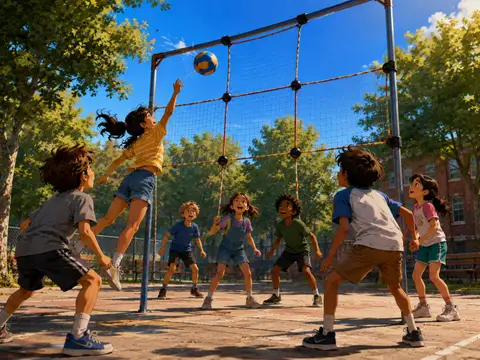
Nine Square in the Air
A head-height frame of nine open squares (built from PVC pipe or a bought kit) turns four square into a volleyball-style battle. Each player defends the square above their head, hitting the ball up and out of their own square into someone else's. Let the ball drop in your square or hit it out of bounds and you're out — everyone rotates toward the center square, and a waiting player steps in at square nine. The player who holds the center longest is the champion.
Game details →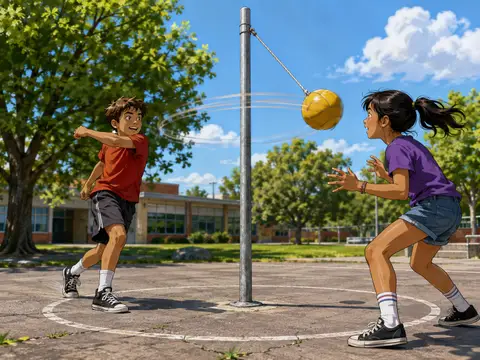
- 2–4 players
- 10 - 20 min
- ~$10/person
Tetherball
A ball hangs from a rope attached to the top of a tall pole. Two players stand on opposite sides and strike the ball in opposite directions; you win by winding the rope completely around the pole in your direction. You may not catch or hold the ball, touch the rope, or step into your opponent's half. Fast, fair, and endlessly repeatable — winner stays on while the next challenger rotates in, which keeps a whole line of players engaged.
Game details →
- 6–14 players
- 10 - 20 min
- ~$2/person
Helium Stick
Two rows of players face each other and hold out index fingers at chest height. Rest a long, light pole (a tent pole or dowel) across everyone's fingers. The task sounds insultingly simple: lower the stick to the ground together, with every finger staying in contact at all times. Instead, the stick mysteriously rises — everyone's tiny upward pressure to "stay in contact" adds up. Groups accuse each other of lifting before they figure out the fix. A ten-minute masterclass in coordination, communication, and blame.
Game details →